

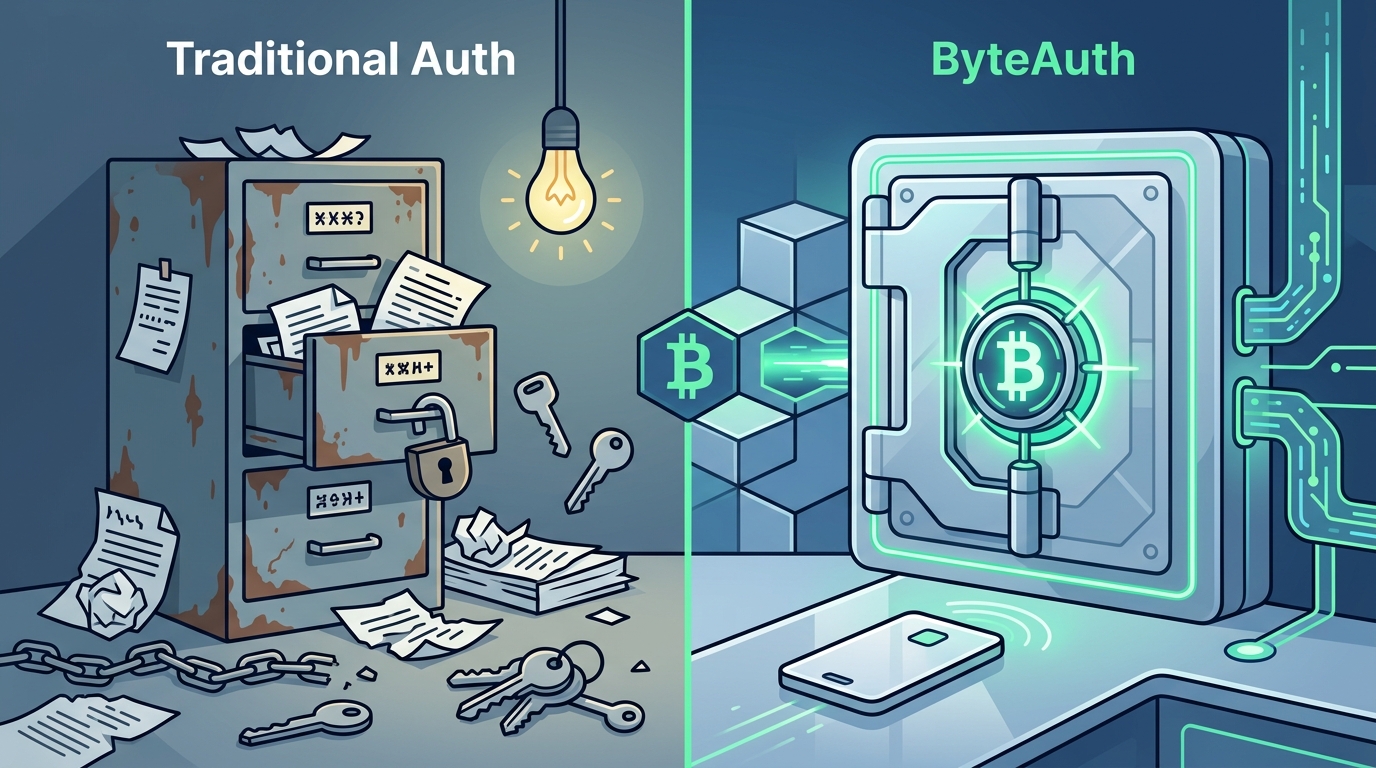
Traditional password-based authentication is fundamentally broken. Recent industry data indicates that 81% of all data breaches involve stolen or weak passwords, creating a massive security liability for enterprises and individual users alike. This statistic highlights the urgent need for a paradigm shift in how digital identities are verified. Byte Federal addresses this critical vulnerability by introducing ByteAuth, a passwordless authentication protocol built directly on Bitcoin cryptography. This article compares ByteAuth against traditional methods like SMS codes, email links, and standard WebAuthn to determine which approach offers superior security and user experience.
The Problem with Passwords
The current standard for digital authentication relies heavily on knowledge-based factors, specifically passwords. This model is inherently flawed because it depends on human memory and behavior. Users frequently reuse passwords across multiple platforms, which means a breach on one site compromises accounts on others. Furthermore, the average user spends approximately 12 hours per year on password resets. This is not just a security issue but a significant productivity drain for organizations.
Phishing attacks have also evolved to target credential harvesting with increasing sophistication. Traditional multi-factor authentication (MFA) methods like SMS codes are vulnerable to SIM swapping attacks. Email-based verification links can be intercepted or phished. The reliance on centralized databases for password storage creates a single point of failure. If a company's database is compromised, millions of user credentials are exposed. This reality necessitates a move toward decentralized, cryptographic identity solutions.
How ByteAuth Works
ByteAuth eliminates the need for passwords entirely by leveraging the secp256k1 elliptic curve cryptography used by Bitcoin. This technology ensures that authentication is both secure and seamless. The process begins when a user visits a login page that displays a dynamic QR code. This code contains a cryptographic challenge that refreshes every 30 seconds to prevent replay attacks.
The user then opens the ByteVault mobile application and scans the QR code. The app uses biometric verification, such as Face ID or Touch ID, to confirm the user's identity. Once verified, the app signs the cryptographic challenge using the user's private key. This signature is sent back to the server for verification. The entire process takes less than three seconds. This method ensures that the user owns the identity without ever typing a password.
ByteAuth also supports self-sovereign identity principles. Users retain full control over their keys. There is no vendor lock-in, as the protocol uses open standards. This approach aligns with the broader mission of financial freedom and transparency that Byte Federal advocates for. For more information on the company's mission, visit the Byte Federal Mission page.
Security Comparison
When comparing ByteAuth to traditional authentication methods, the differences in security posture are stark. Traditional passwords are susceptible to brute force attacks, dictionary attacks, and credential stuffing. Even with hashing, weak passwords can be cracked quickly. SMS-based MFA is vulnerable to SIM swapping, where attackers transfer a victim's phone number to a new device. Email-based MFA can be compromised if the email account itself is breached.
ByteAuth offers phishing resistance because the cryptographic challenge is bound to the specific domain. A phishing site cannot forge the signature without the private key. It also enforces biometric verification, ensuring that only the legitimate user can authorize the login. This is a significant advantage over WebAuthn, which may not always enforce biometrics depending on the platform. ByteAuth also provides cross-device compatibility, allowing users to authenticate from any device that can scan the QR code.
The following table summarizes the key security differences between ByteAuth and traditional methods.
| Feature | Traditional Passwords | SMS MFA | ByteAuth |
|---|---|---|---|
| Phishing Resistant | No | No | Yes |
| Biometric Enforcement | No | No | Yes |
| Self-Custody | No | No | Yes |
| Cross-Device Support | Yes | Yes | Yes |
| Recovery Method | Email/Phone | Phone | Seed Phrase |
User Experience Analysis
User experience is a critical factor in the adoption of any authentication technology. Traditional passwords require users to remember complex strings of characters. This leads to frustration and frequent resets. SMS codes require users to switch apps or check their text messages, adding friction to the login process. Email links require users to open their inbox and click a link, which can be slow and unreliable.
ByteAuth streamlines the login process into a simple scan-and-confirm action. Users do not need to remember anything. The biometric verification is fast and familiar to most smartphone users. The sub-3-second login time is significantly faster than waiting for an SMS code to arrive or an email to load. This efficiency reduces support tickets related to password resets and improves overall user satisfaction.
For developers, ByteAuth offers SDKs for popular frameworks like Laravel and Next.js. This makes integration straightforward. The ByteAuth documentation provides detailed guides for implementation. The open-source nature of the SDKs allows for greater transparency and community support. This is a key advantage for enterprises looking to customize their authentication flows.
Pricing and Integration
Byte Federal offers competitive pricing for its authentication services. The company provides a free tier for developers to test the integration. Paid plans are available for production use, with pricing based on the number of monthly active users. This scalable model ensures that businesses of all sizes can adopt ByteAuth without significant upfront costs.
Integration is designed to be developer-friendly. The Laravel SDK includes Livewire components and webhook handlers out of the box. The Next.js SDK includes React components and TypeScript support. This reduces the time required to implement secure authentication. For more details on the API, visit the Byte Federal APIs page.
Byte Federal also offers a crypto wallet and POS systems for businesses looking to accept cryptocurrency payments. These services complement the authentication solution by providing a complete financial ecosystem. The Best Crypto Wallet guide provides additional insights into the company's offerings.
Key Takeaways
- ByteAuth uses Bitcoin's secp256k1 cryptography for superior security.
- Traditional passwords are involved in 81% of data breaches.
- ByteAuth eliminates the need for passwords and SMS codes.
- Login time is under 3 seconds with biometric verification.
- ByteAuth is phishing-resistant and supports self-sovereign identity.
- SDKs are available for Laravel and Next.js.
- Byte Federal serves over 42 states with its ATM network.
Frequently Asked Questions
Is ByteAuth free to use?
ByteAuth offers a free tier for developers to test the integration. Paid plans are available for production use based on usage.
How does ByteAuth prevent phishing?
ByteAuth binds the cryptographic challenge to the specific domain. A phishing site cannot forge the signature without the user's private key.
What devices are supported?
ByteAuth supports any device that can scan a QR code and has a compatible mobile app for biometric verification.
Can I use ByteAuth with my existing website?
Yes, ByteAuth provides SDKs for Laravel, Next.js, and other frameworks to facilitate easy integration.
What happens if I lose my phone?
Users can recover their identity using their seed phrase. This ensures that users retain control over their identity.
Is ByteAuth secure?
Yes, ByteAuth uses the same cryptography as Bitcoin, which has proven secure for over 15 years.
How do I get started?
You can get started by visiting the ByteAuth developer portal and requesting an API key.
Get Started with ByteAuth
It is time to upgrade your authentication strategy. ByteAuth offers a secure, fast, and user-friendly alternative to traditional passwords. Join the growing number of developers and enterprises adopting Bitcoin-powered security. Visit the Byte Federal homepage to learn more about our services and get started today.