

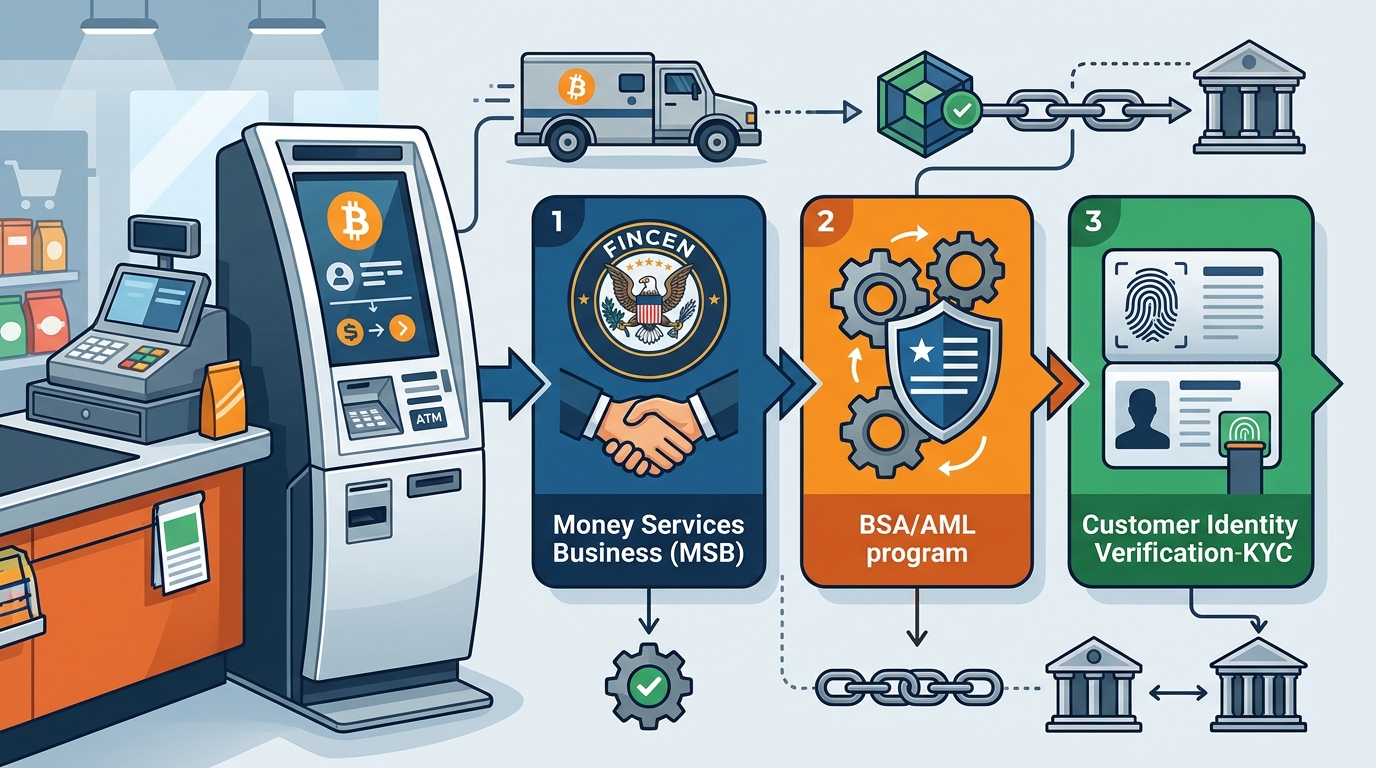
Bitcoin ATM operators must register as Money Services Businesses with FinCEN, implement a BSA/AML program, and verify customer identity through KYC protocols. These federal requirements ensure that physical kiosks operating inside retail stores meet the same anti-money laundering standards as traditional financial institutions. Byte Federal operates a FinCEN-registered network that adheres to these strict regulatory frameworks to protect both merchants and consumers.
Federal Registration and Money Services Business Status
Operating a Bitcoin ATM in the United States requires federal registration. A Bitcoin ATM operator is a financial institution that must register with the Financial Crimes Enforcement Network (FinCEN) as a Money Services Business (MSB). This registration is mandatory for any entity that transmits funds or facilitates the exchange of value, including digital assets. Without this status, an operator cannot legally process transactions at retail locations.
FinCEN registration involves submitting a Form 102 and maintaining an active status. The operator must also designate a principal officer responsible for compliance. This federal oversight ensures that the entity is subject to federal anti-money laundering laws. For retail hosts, partnering with a registered operator mitigates legal risk and ensures that the kiosk operates within the bounds of federal law.
Anti-Money Laundering and BSA Requirements
Compliance extends beyond registration to active monitoring of transactions. The Bank Secrecy Act (BSA) requires operators to implement a written Anti-Money Laundering (AML) program. This program must include internal controls, independent audits, and designated compliance officers. The goal is to detect and report suspicious activity that may indicate money laundering or terrorist financing.
Operators must file Suspicious Activity Reports (SARs) with FinCEN when transactions meet specific thresholds or appear unusual. For example, a single transaction exceeding $10,000 triggers a Currency Transaction Report (CTR). These reporting mechanisms create a paper trail that law enforcement agencies can use to investigate illicit financial flows. Byte Federal maintains a dedicated BSA/AML program to ensure all transactions are monitored and reported according to federal guidelines.
Know Your Customer and Identity Verification
Identity verification is the cornerstone of retail Bitcoin ATM compliance. Know Your Customer (KYC) rules require operators to verify the identity of users before allowing transactions. This process typically involves scanning a government-issued photo ID and capturing a live selfie for biometric matching. The level of verification often scales with the transaction amount, a practice known as tiered KYC.
For smaller transactions, a phone number verification may suffice. For larger amounts, full identity verification is required. This tiered approach balances security with user convenience. It ensures that high-value transactions are subject to stricter scrutiny. Retail locations benefit from this system because it reduces the risk of fraud and identity theft at the point of sale.
State Regulations and Local Licensing
Federal rules are only part of the compliance landscape. State regulations vary significantly across the United States. Some states require specific licenses for money transmission or digital asset services. Others have enacted laws specifically targeting Bitcoin ATMs, such as limits on transaction sizes or requirements for physical security. Operators must navigate this patchwork of state laws to ensure their kiosks are legal in every location where they are installed.
For instance, certain states may require operators to post specific disclosures about the risks of cryptocurrency. Others may mandate that ATMs be installed in secure, well-lit areas. Compliance with state laws is essential for maintaining a broad network. Byte Federal operates across 42+ U.S. states, ensuring that each location meets the specific regulatory requirements of its jurisdiction.
Physical Security and Data Protection Standards
Compliance also encompasses the physical and digital security of the ATM itself. Operators must ensure that kiosks are tamper-resistant and that data transmitted between the device and the backend is encrypted. Industry standards like ISO 27001 provide a framework for information security management. Achieving such certification demonstrates a commitment to protecting customer data and maintaining the integrity of the transaction process.
Physical security measures include robust enclosures and strategic placement in high-traffic, secure retail environments. Digital security involves using encryption to protect communication channels. These measures are critical for building trust with both retail hosts and end users. A secure infrastructure is a prerequisite for long-term compliance and operational stability.
Key Takeaways
- Bitcoin ATM operators must register with FinCEN as Money Services Businesses.
- A written BSA/AML program is required to monitor and report suspicious activity.
- Know Your Customer (KYC) protocols mandate identity verification for all users.
- State regulations vary, requiring operators to obtain local licenses where applicable.
- Physical and digital security standards, such as ISO 27001, protect data and hardware.
- Compliance with federal and state laws mitigates legal risk for retail hosts.
Frequently Asked Questions
Do Bitcoin ATM operators need a federal license?
Yes, operators must register with FinCEN as a Money Services Business. This is a federal requirement for any entity facilitating the exchange of digital assets.
What is a BSA/AML program?
How does KYC work at a Bitcoin ATM?
Users must scan a government-issued ID and provide a selfie for verification. The level of verification may depend on the transaction amount.
Are state licenses required for Bitcoin ATMs?
It depends on the state. Some states require specific licenses for money transmission or digital asset services, while others have specific ATM regulations.
Why is ISO 27001 certification important?
ISO 27001 certification demonstrates that an operator has implemented robust information security management practices. It helps protect customer data and ensures the integrity of transactions.
Can retail stores host a Bitcoin ATM without compliance?
No, retail stores should only partner with compliant operators. Hosting a non-compliant ATM can expose the store to legal and financial risks.
Conclusion
Navigating the complex landscape of Bitcoin ATM compliance is essential for any operator or retail host. By adhering to federal registration, BSA/AML, and KYC requirements, operators ensure that our services are secure and legal. Byte Federal is committed to maintaining the highest standards of compliance, providing a safe and reliable experience for all users. To learn more about our compliance framework, visit our BSA/AML Program page.